Ask a family why they left a tutoring school and the answer is often not "the lessons were bad". It is some version of "we didn't really know how it was going". The child came home, said lessons were fine, and months passed without anyone from the school saying anything specific. When the invoice for next term arrived, there was nothing to weigh it against.
Good communication with parents is not about volume. A school that sends a newsletter every week and never mentions the child by name is communicating a lot and saying nothing. What works is a small number of messages, sent at predictable moments, each one specific to the child.
This playbook gives you the schedule and a template for each message. The templates are starting points: rewrite them in your own voice, and in the language your families actually use.
Five principles before the templates
Specific beats frequent. One sentence about something the child actually did is worth more than a weekly bulletin.
Predictable beats impressive. Families trust a school that does what it said it would, when it said it would. If you promise a mid-term update, send it in week seven, every term.
Bad news early, and in person where possible. A problem raised in week four is a conversation. The same problem raised in week fourteen is a complaint.
Every message has one job. A payment reminder that also announces a holiday closure and asks for feedback does none of the three well.
Make replying easy. End with a question or a clear next step. A message that cannot be answered does not start a conversation.
The schedule
| When | Message | Who sends it |
|---|
| On enrollment | Welcome and practical details | Admin |
| Day before first lesson | Reminder | Admin |
| After first lesson | How did it go? | Teacher or admin |
| Every absence, same day | We missed you today | Admin |
| Second absence in a row | A personal call | Owner or senior teacher |
| Week 4 | 30-day check-in | Teacher |
| Week 7 | Mid-term progress note | Teacher |
| Invoice due date and after | Payment reminders | Admin |
| Week 10 | Next-term intentions | Admin |
| Week 13 | End-of-term report | Teacher |
| Week 14 | Renewal conversation | Owner or senior teacher |
Everything else, such as holiday closures, events and timetable changes, is operational and should be sent when needed, separately, so it does not bury the messages above.
Templates
Replace the parts in square brackets. Keep the messages short; most parents read them on a phone between other things.
Welcome, on enrollment
Hi [parent name], welcome to [school]! [Child] is booked into [group name] with [teacher], every [day] at [time], starting [date], in [room/location].

Your first invoice is [amount], due [date]. You can pay by [methods].

If anything about the schedule doesn't work, just reply here, and we'll sort it out before the first lesson.
Everything a family needs in one message, so nobody arrives on the wrong day. It ends by inviting a reply, which tells the family this channel is two-way.
After the first lesson
Hi [parent name], [child] had their first lesson today. [Teacher] mentioned [one specific thing: they were confident in the speaking activity / they found the reading a bit fast]. How did [child] feel about it at home?
The one specific detail is the whole point. It proves somebody noticed the child. The question at the end is genuine: the answer tells you early whether the level is right.
Absence, same day
Hi [parent name], we missed [child] at [group name] today. Is everything okay? If [he/she/they] would like the materials from today's lesson, we can send them over.
Neutral, not accusing, and useful. Sent on the same day it catches wrong-day mistakes and illness quickly; sent a week later it reads as a complaint.
Second absence in a row: a call, not a message
Two absences in a row is one of the clearest early warnings a school gets that a student is drifting away. This deserves a phone call from someone senior, not a message. A useful structure:
- Ask how the child is.
- Ask, openly, whether anything about the class isn't working: time, level, group, teacher.
- Listen more than you talk.
- Agree one concrete next step, even if it is only "we'll see [child] on Thursday".
Students who quietly leave covers the pattern this call is designed to interrupt.
30-day check-in, week 4
Hi [parent name], [child] has now been with us for a month. [Teacher] says [one thing going well]. We're also working on [one thing to improve].

Is the level feeling right from what you see at home? Anything we should know?
One strength, one area of work, one question. It establishes the pattern the mid-term note will follow.
Mid-term progress note, week 7
Hi [parent name], a quick update on [child] halfway through the term.

Going well: [specific skill or behavior, with an example].
Working on: [specific area], and in class we're doing [what].
At home, it would help if [child] could [one small, realistic thing].

Happy to talk if you'd like more detail.
The "at home" line turns the parent from an audience into a participant, and it has to be small enough to actually happen. "Read for ten minutes before bed" works. "Practice more" does not.
Payment reminders
Keep the tone flat and factual, and escalate by adding people, not adjectives.
Due date:
Hi [parent name], a reminder that [child]'s invoice for [period] of [amount] is due today. You can pay by [methods]. Thank you!

Seven days after:
Hi [parent name], our records show [child]'s invoice for [period] of [amount] is still open. If you've already paid, could you send us the transfer details so we can match it? If there's a problem, just let us know.

Fourteen days after: a personal call from the owner or manager.
The seven-day message offers an easy way out ("if you've already paid") because often the family has paid and the transfer simply has not been matched. Collecting tuition without nagging goes deeper on the whole process.
Next-term intentions, week 10
Hi [parent name], we're starting to plan next term's timetable. Are you planning for [child] to continue? Just reply yes, no or not sure. There's no commitment at this point; it helps us keep the right place for [child].
The three-option answer matters. "Not sure" is the most valuable reply you can get: it tells you exactly which families need a conversation.
End-of-term report, week 13
The report deserves its own care. The short version: fewer grades, more sentences; one or two specific achievements; one clear priority for next term; and written so a parent who has not seen a single lesson understands it. End-of-term reports parents actually read covers the format in detail.
The renewal conversation, week 14
For families who said "not sure", a message to open the conversation, then a call:
Hi [parent name], thanks for letting us know you're not sure about next term. Could we have a quick chat this week? I'd like to hear what's on your mind, whether it's the schedule, the level or anything else. Would [day/time] work, or is another time better?
Difficult messages
Some messages need more care than a template can give. A few rules help.
A teacher is leaving. Tell families before the teacher's last week, name the new teacher, and say what stays the same (group, time, materials). Families cope well with change they hear about early and badly with change they discover in the classroom.
A group is merging or moving. Explain the reason in one honest sentence, offer an alternative if the new time does not work, and give families a reply deadline.
A behavior issue. Always a call or a meeting, never a message first. Describe what happened, not what kind of child they are. Ask for the parent's view before proposing anything.
A mistake by the school. A wrong invoice, a lesson canceled without notice, a lost piece of work. Say what happened, say what you have done about it, and do not explain at length why it was not really your fault. A short, plain apology is almost always better received than a long justification.
Choosing channels
Most schools use a mix of chat apps, email, phone calls and occasionally a parent portal. The channel matters less than two rules.
Group chats are for logistics, not for individual children. A message about one child's progress or payment does not belong in front of thirty other families, however convenient it is.
Pick one channel per kind of message, and stick to it. If progress notes sometimes come by chat, sometimes by email and sometimes not at all, families stop looking for them.
Measuring whether it works
Three numbers tell you whether the playbook is working:
- Share of absences followed up the same day. Aim for all of them.
- Share of families who received a mid-term note. Again, all of them.
- Renewal rate among families who got every scheduled message, compared with those who did not. If the first group renews at a clearly higher rate, you have your evidence, and your argument for the time it takes.
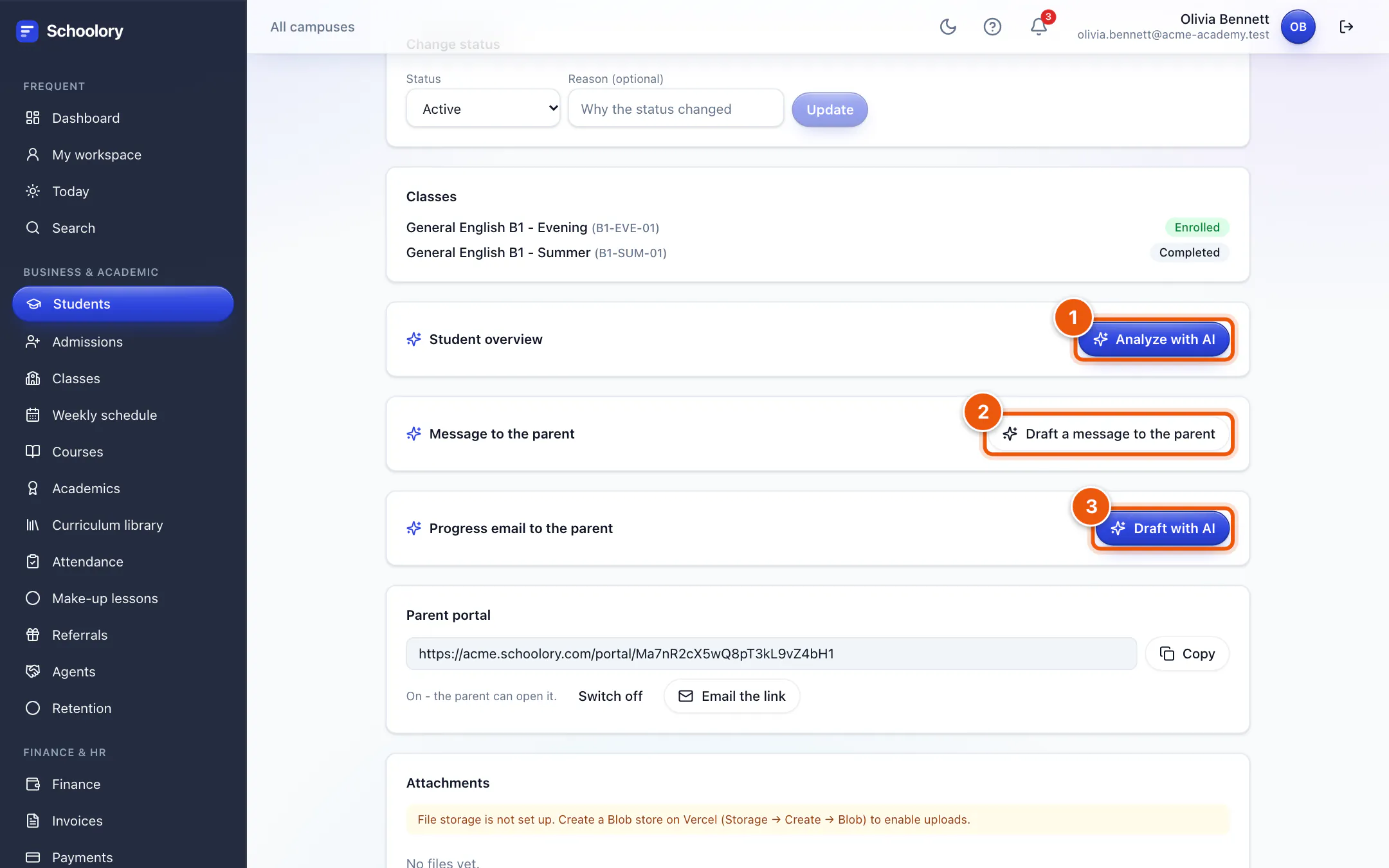
The hard part of this playbook is not writing the messages. It is knowing, every week, which families are due which message, and which absences have not been followed up. When attendance, invoices and the parent channel live in one system, that list builds itself. That is the part Schoolory is built for.